Exhibiting at World Heritage Site Nikko Tosho-gu
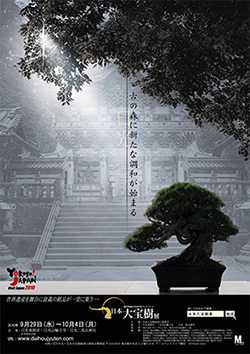
This rare exhibition celebrated some of the oldest and most valuable bonsai trees in Japan. Many of the bonsai had never been viewable by the general public before, making this a must-see event.
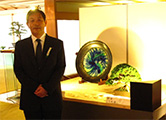
These priceless bonsai were displayed among ceramic art created by living national treasures, with some pieces valued at millions of yen. To the delight of Ishigaki-yaki Pottery Studio, pieces by Haruhiko Kaneko were also selected to be part of the exhibition and were displayed alongside masterpieces by living national treasures. Some of the bonsai were well over 500 years old, still others close to a thousand, yet thanks to the formidable knowledge of the bonsai experts who have cared for the trees over time, none of them is more than one metre in height. Bonsai can encapsulate many things: a cosmic view, a sense of time, and a sense of seasonality. Bonsai owners would only pass their precious trees into the care of someone who shared the same philosophy and beliefs. As such, they are expressions of great and mutual respect over the centuries. The exhibition was held in the Kyakuden Guest Hall, where the Emperor and Empress of Japan have stayed as well as other members of the Imperial Family.
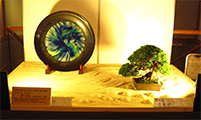
The theme of the event, held in the Tosho-gu World Heritage Site, was “coexistence with nature”. This resonated well with the underlying philosophy behind Ishigaki-yaki, namely to express in our pieces both human happiness and the eternal beauty of the Okinawan seas. This allowed the artist, Haruhiko Kaneko, to realise a world-first collaborative piece between pottery and bonsai. If our water, air, and food become polluted, we will wither and die. Kaneko placed a dish, representing the sea?water?as the ultimate source of all life, and a bonsai, representing the mountains which nurture the air, in a miniature garden, filled it with coral sand, to represent Earth seen from the universe and to communicate a message about how we should treasure our natural environment.
The spatter-type pattern characteristic of yuteki tenmoku can be read as an expression of the multitude of stars in our university, and the sea, covering seven tenths of the surface, is representative of Earth. This piece is intended as an expression of the wish to see the beauty of Earth and her nature, as seen from beyond the stars, remains forever.
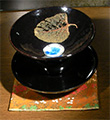
In the hekikai konoha tenmoku tea bowl, the leaf is intended to represent the mountains, thereby encapsulating both the mountains and the oceans, as seen from space, within the confines of a delicate tea matcha tea bowl.